

For yacht builders, refit yards and owners planning a teak deck, thinner material can appear to be the obvious way to reduce cost. Less timber is used per square metre, so the assumption is simple: a 12 mm or 13 mm board should be cheaper than a 21 mm, 23 mm or 27 mm board.
With premium quartercut teak, the production reality is more complicated. The final cost is not determined only by the volume of the finished board. It is also affected by how efficiently the mill can recover straight-grain material from the log, how much is lost through saw kerf and calibration, and how selective the cutting must be to maintain a consistent yacht-grade specification.
Thin quartercut teak creates proportionally more production loss
Every cut removes material. Saw kerf, trimming, planing and calibration are unavoidable parts of producing finished teak decking. When a thick board is produced, those losses represent a smaller proportion of the finished volume. When the same operations are used to produce a thin 12 mm or 13 mm board, the processing loss becomes much more significant relative to the final product.
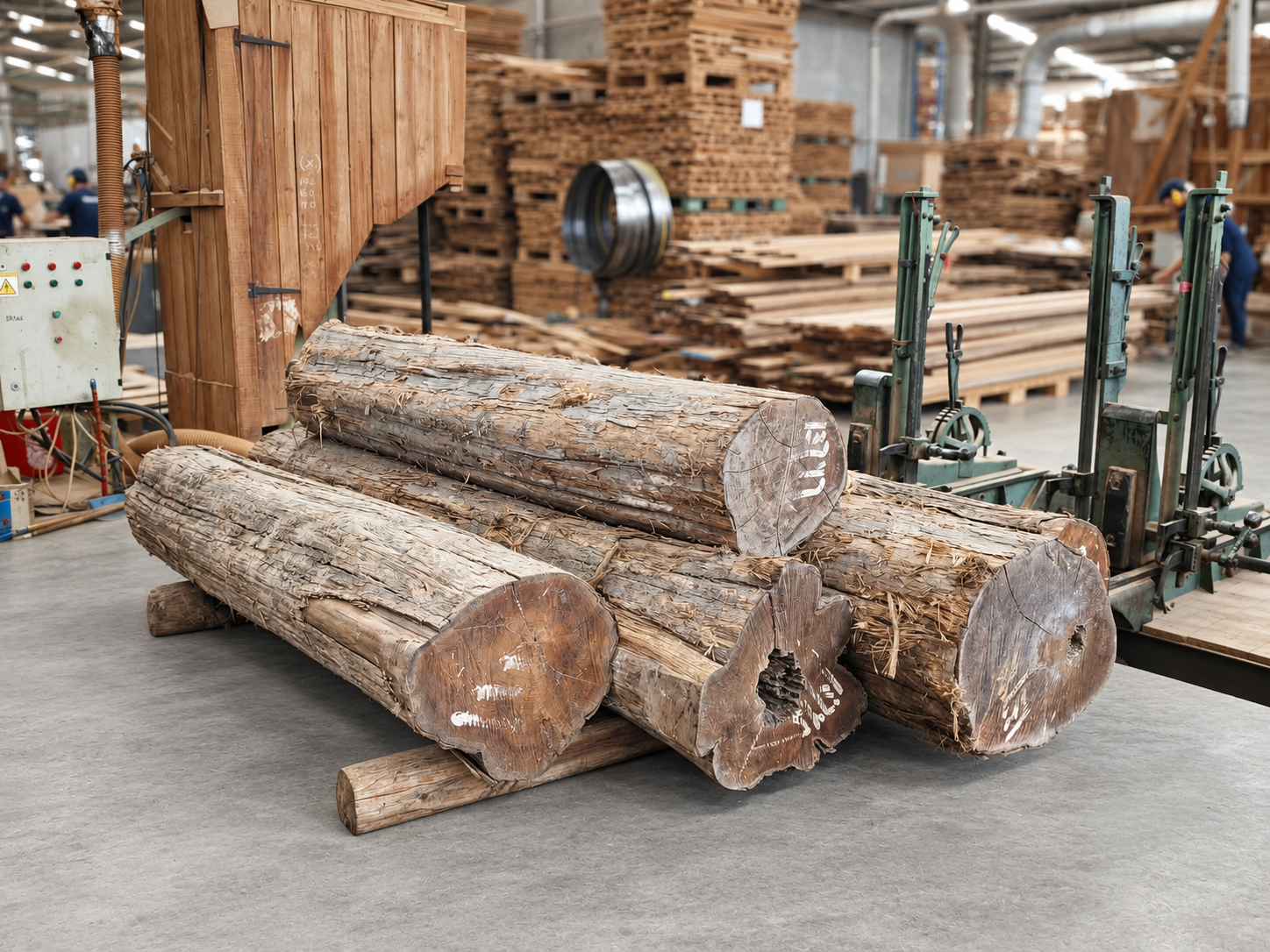
This effect matters even more with quartercut teak decking. The mill is not simply cutting any board that fits the dimensions. Material must be selected and sawn to achieve the predominantly straight vertical grain expected for premium yacht decking. Recovery therefore depends on both geometry and grain orientation.
Current production references
For current professional quartercut teak programs, full-thickness production is commonly discussed around 21 mm, 23 mm and 27 mm. Thin yacht decking requirements around 12 mm or 13 mm can also be produced, but they should be treated as a different production category because the recovery is less efficient.
Typical decking widths are concentrated around approximately 45–50 mm, 63–65 mm, 75 mm and 90–100 mm depending on the thickness and project. Wider quartercut pieces above the normal decking range are handled separately as margin, border or special components because they require larger and more selective raw material.
Price per cubic metre and price per square metre are different questions
For a flat board, the theoretical timber volume required per square metre is directly related to thickness. A thinner board uses less cubic volume per square metre. But the price of the timber itself can rise when the requested profile creates poor recovery.
This is why thin decking can use less timber per square metre while still carrying a higher price per cubic metre. A professional comparison should consider thickness, width, length, grain requirement and machining together.
- Thickness: determines theoretical timber volume per square metre.
- Width: affects quartercut recovery and the size of log required.
- Length: affects selection pressure and usable recovery.
- Grain requirement: premium vertical-grain selection reduces the raw material that can be accepted.
- Machining: rebates, profiling and final calibration can add processing and additional loss.
A thicker wear layer can be valuable on a yacht
A thicker teak deck provides a larger wear layer. Yacht decking may be sanded during maintenance or refit work over its service life, so a thicker starting profile gives the owner and yard more material to work with before the deck approaches its minimum practical thickness.
This does not mean that every yacht should use 21 mm or 23 mm material. Weight, existing deck structure, refit constraints and installation design can make a thinner specification entirely appropriate. Thin material should simply be selected for a technical reason, not because it looks cheaper in a dimensional table.
Specify the complete deck package
The most efficient way to quote professional yacht decking is to review the specification as a complete package. Nauteaka recommends providing finished thickness, decking widths, margin dimensions, preferred length range, acceptable short lengths, plain S4S or rebate requirements, estimated volume, destination and documentation requirements.
This allows production to evaluate recovery across the complete order instead of pricing each component in isolation.
Flexibility has real commercial value
A yacht builder who can accept a practical mix of lengths, standard decking widths and a production-efficient thickness gives the mill more ways to recover usable quartercut material from each selected log. That can improve both availability and the commercial structure of the order.
For current dimensions, availability and project-specific production, visit our quartercut teak decking page or send Nauteaka your deck specification.