
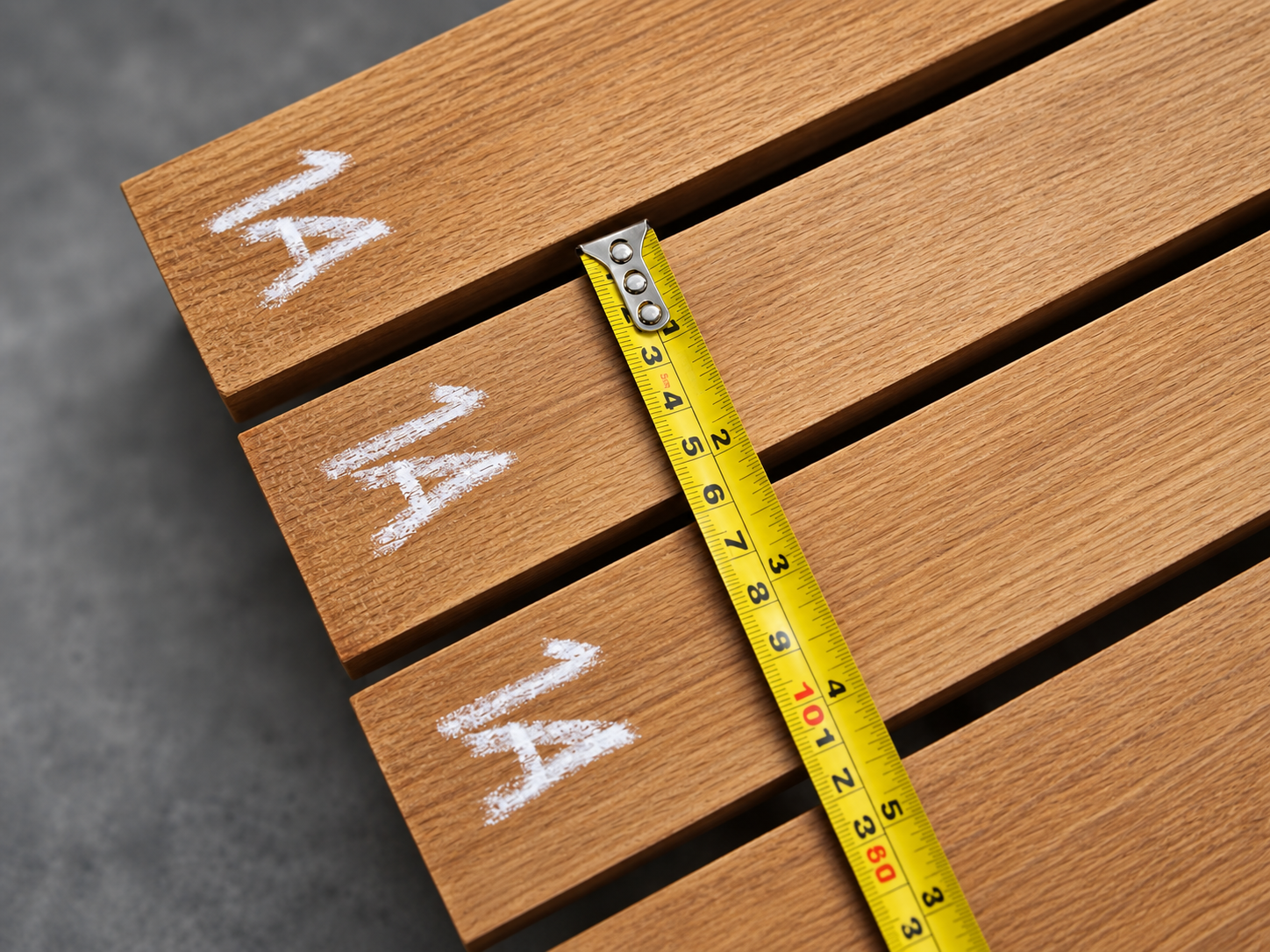
For yacht builders, refit yards and professional marine buyers, specifying teak involves more than selecting the species. The way the timber is sawn has a direct influence on grain appearance and dimensional behaviour.
This is why quartercut teak — also commonly described as quarter-sawn teak or vertical-grain teak — is so closely associated with high-quality yacht decking.
What is quartercut teak?
Quartercut teak is produced by orienting the cut so that the growth rings run predominantly perpendicular to the face of the finished board. This produces the straighter grain pattern commonly seen across premium yacht and superyacht decks.
The terms quartercut, quarter cut and quarter-sawn are commonly used internationally for the same general cutting orientation. Exact terminology may differ between shipyards, distributors and timber buyers.
How is flat-sawn teak different?
Flat-sawn teak is cut with a different relationship between the board and the tree's growth rings. It generally produces broader and more varied grain patterns across the face of the board.
That appearance can be desirable in many furniture and architectural applications, but yacht decking usually places a much stronger emphasis on consistent straight grain across multiple boards.
Why grain orientation matters on a yacht deck
A yacht deck is a highly visible surface built from many individual boards positioned beside one another. Variations that may be relatively unimportant in another timber application become much more obvious when repeated across a large deck.
Quartercut material offers several characteristics particularly relevant to this environment:
- Straighter and more consistent visible grain.
- Greater dimensional stability across the width of the board.
- A more uniform appearance across large deck areas.
- Better alignment with the visual specification normally expected from premium yacht decking.
Quartercut teak specifications
Nauteaka's quartercut teak decking specification uses Tectona grandis and includes standard thicknesses of 9 mm, 12 mm and 15 mm.
Depending on thickness and specification, standard widths range approximately from 45 mm to 95 mm, while standard length ranges extend from approximately 900 mm to 2200 mm. Custom requirements can be reviewed with lengths up to approximately 3000 mm, subject to available material.
The reference technical specification states a moisture content of 12–14% and density of approximately 650–750 kg/m³.
Quartercut does not replace proper material selection
Specifying quartercut teak is important, but the cutting orientation alone does not define the quality of a yacht deck.
Professional purchasing should also consider board dimensions, length distribution, machining, moisture condition, visual selection, consistency between boards, legality documentation and the specific requirements of the shipyard or deck contractor.
Quartercut should be treated as part of the complete decking specification, not as a substitute for proper material selection and quality control.
What professional buyers should specify
When requesting quartercut teak for a yacht or superyacht project, buyers should ideally provide:
- Required thickness.
- Required width or acceptable width range.
- Required lengths and acceptable length distribution.
- Edge profile and machining requirements.
- Estimated project quantity.
- Certification or legality requirements.
- Destination and required delivery schedule.
Providing these elements at the beginning allows the available material, selection criteria and project requirements to be reviewed together.
Quartercut teak supply for professional yacht projects
Nauteaka specializes in quartercut teak decking for yacht builders, refit yards, boat manufacturers and specialist marine distributors. There is no fixed minimum order quantity, and both project-specific and recurring requirements can be reviewed according to specification and availability.
For detailed dimensions and technical information, visit the quartercut teak decking technical page .