
One of the most common questions in yacht teak procurement is also one of the easiest to oversimplify: what sizes are standard?
Quartercut teak is a natural material, and the answer depends on the relationship between thickness, width, length, grain orientation and the amount of selective cutting required. A practical specification separates normal decking strips from wider margins and special components.
Current standard thickness references
Nauteaka's current production references for yacht decking are:
- 13 mm — thin decking / refit-oriented applications.
- 21 mm — full-thickness decking.
- 23 mm — full-thickness decking.
- 27 mm — full-thickness decking.
Custom thin profiles around 12 mm can also be discussed. Thin material should not automatically be assumed cheaper per cubic metre because additional cutting and calibration reduce recovery.
Typical deck-strip widths
For normal deck strips, current production discussions are generally concentrated around:
- 45–50 mm;
- 63–65 mm;
- 75 mm;
- approximately 90 mm, depending on the project.
Final width availability must always be confirmed together with thickness and volume. Quartercut recovery changes materially as width increases.
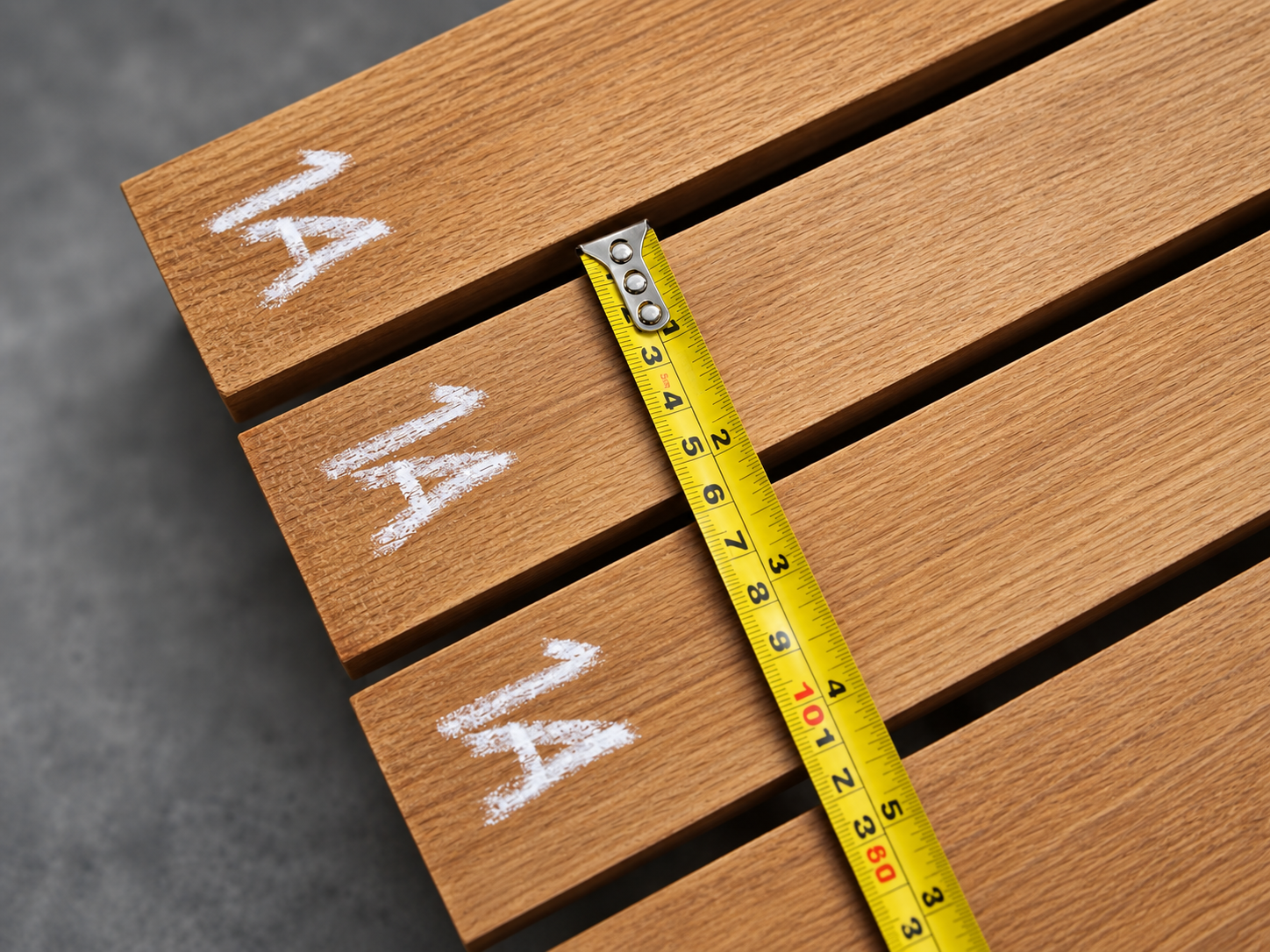
Decking strips and margin boards are not the same product
Current production references classify widths such as 100/105 mm, 120 mm and 150 mm as margin or border material, rather than ordinary deck strips.
That distinction matters because wide quartercut boards require larger and more selectively cut sections of the log. They may be used for margins, king planks, borders and other yacht details, but their availability and commercial structure should be evaluated separately from the main decking field.
Very wide pieces such as 120 mm and 150 mm are project-based items with more limited raw-material availability. They should not be assumed available in the same volume as narrow deck strips.
Standard length range and average
For current yacht teak discussions, Nauteaka works with a standard random-length range of approximately 1,800–3,000 mm, targeting an average around 2,400 mm across the batch.
This is a length mix rather than a promise that every board will be 2.4 metres or longer. Professional buyers should define both the acceptable range and any minimum percentage requirements before production.
Shorter lengths can improve timber recovery
If the project can use shorter random pieces — for example approximately 900–1,500 mm in selected areas — the mill has more options to recover usable quartercut material from each log.
That can improve supply efficiency and may allow a better commercial structure. Short lengths can be particularly useful around deck details, curved areas, steps, platforms or layouts where every component does not need to span a long uninterrupted distance.
Lengths above 3,000 mm are special production
Boards above 3,000 mm require more selective raw material. Nauteaka's current commercial reference applies a 5% surcharge to lengths above 3,000 mm, subject to material availability and feasibility for the requested section.
Longer does not automatically mean better. A yacht deck layout designed around realistic length distribution can use timber much more efficiently than one that specifies maximum length everywhere.
Square-edged or rebated?
S4S square-edged blanks are the simplest dimensional reference. If a caulking rebate is required, the buyer should provide a drawing confirming the profile, rebate depth and edge geometry.
Nauteaka does not assume one standard rebate for every market or yard. Machining requirements should be confirmed before the order is finalized.
What should be included in a dimension request?
- finished thickness;
- deck-strip widths and quantities;
- margin / king plank / border dimensions;
- acceptable minimum and maximum lengths;
- desired average length if relevant;
- short-length allowance;
- S4S or detailed rebate drawing;
- total square metres or cubic metres;
- destination and required schedule.
A complete dimensional schedule gives production far more useful information than a request such as “quote yacht teak 65 mm wide.”
See our main Quartercut Teak Decking specification page or send Nauteaka your dimension schedule.